


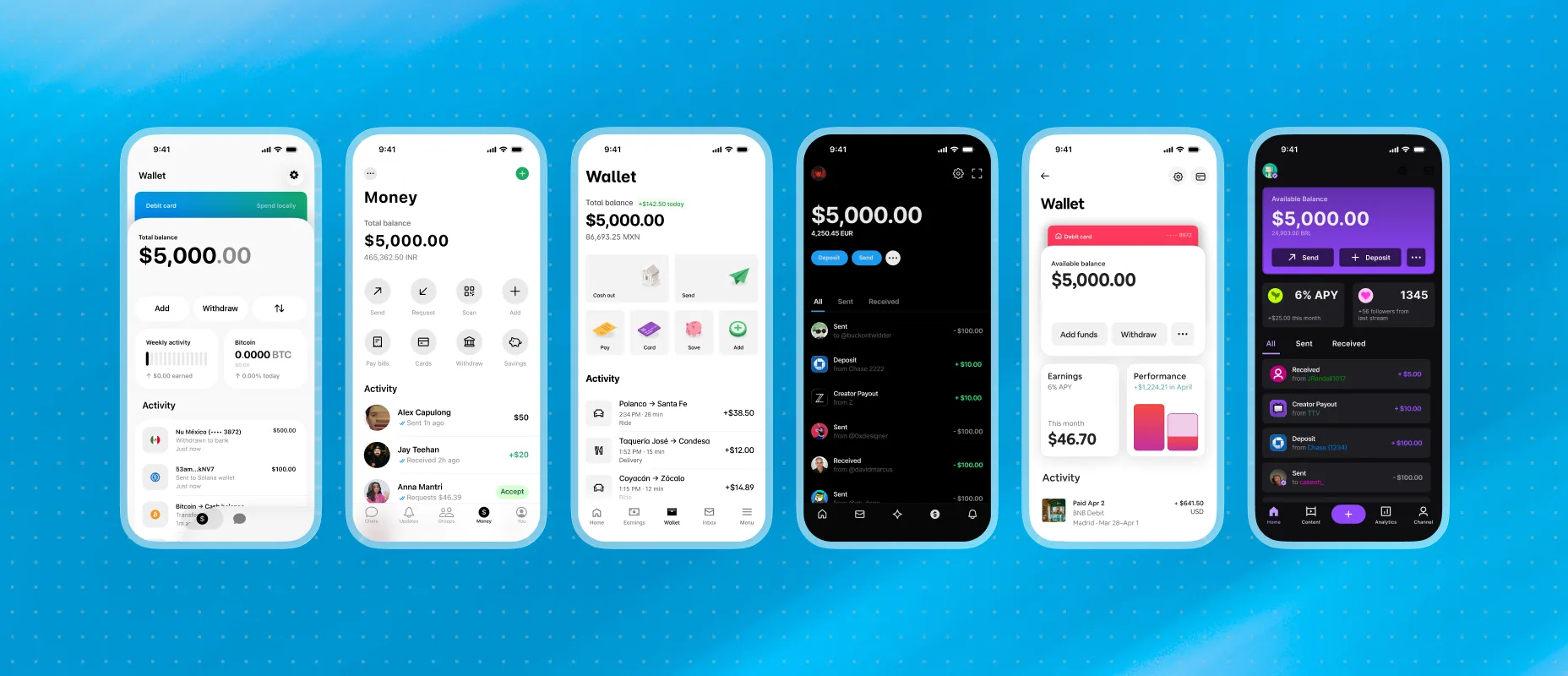
type: "EMBEDDED_WALLET" that participates in the standard Grid customer, quote, transaction, and webhook flows.
Why a Grid Global Account?
- Self-custody. Grid never has unilateral access to move user funds, and neither do you. The customer’s device is the only party that can authorize a transaction.
- Stablecoin-denominated. Balances are held as stablecoins like Brale-issued USDB. Use the standard
/quotesAPI to convert in from fiat or out to any supported Grid bank-account rail (ACH, PIX, CLABE, UPI, IBAN, UMA, …). - Grid-native. You reuse the customer, internal-account, quote, transaction, and webhook primitives you already integrated for Payouts or P2P. The only thing that’s new is an auth + signing layer at the account.
- Built on Bitcoin. Global Accounts run on Spark, a Lightning-compatible Bitcoin L2 that supports instant, low-fee Bitcoin and Stablecoin transfers. You get the benefits of running on Bitcoin, the most neutral, decentralized, and secure network for money.
Payment flow
Grid Global Accounts ride on the same/quotes + /quotes/{id}/execute pattern as every other Grid payment. The only thing that’s different is that outbound transfers need a client signature.
- Incoming funds. Funding an account works like any other internal account. Create a quote with the Global Account as the
destination, execute it, and Grid converts the source currency into USDB and credits the account. No customer approval needed — incoming value is passive. - Outgoing funds. Withdrawals and transfers out require the customer to authorize them on their device. Grid returns a
payloadToSignin the quote’spaymentInstructions; the client signs those bytes with its session signing key and passes the base64 signature as theGrid-Wallet-Signatureheader on/quotes/{id}/execute. Only then does Grid release the funds.
Architecture
Three parties participate in every signed action:| Party | Role |
|---|---|
| Client | The customer’s device (browser, iOS app, or Android app). Generates the client key pair, runs WebAuthn, decrypts the session signing key, and signs outbound requests. |
| Integrator backend | Your server. Holds your Grid API credentials, brokers every call to Grid on behalf of the client, and issues WebAuthn challenges for initial passkey registration. |
| Grid | Verifies auth credentials, issues session signing keys (encrypted to the client’s public key), and enforces that every account action is authorized. |
Auth credentials, client keys, and session signing keys
Three distinct pieces of crypto collaborate to authorize actions on the Global Account (withdrawals, credential changes, session revocations, and wallet exports):| Piece | Where it lives | How long it lives | What it proves |
|---|---|---|---|
| Auth credential — passkey, OIDC token, or email OTP | Registered on the account; the passkey itself lives on the authenticator, OIDC on your IdP, OTP in the user’s inbox | Until the customer revokes it | ”I am the human who owns this account.” Used to authenticate the user at the start of each session. |
| Client key pair (P-256) | Generated on the client device for each verification request; private key stays in device-local secure storage | One verification request | Binds a given session signing key delivery to the exact device that asked for it — Grid encrypts the session to this public key, so only this device can decrypt. |
| Session signing key (P-256) | Issued by Grid, sealed to the client public key, decrypted and held on the device for the session’s lifetime | 15 minutes (default) | “This specific account action was approved on an authenticated device.” Signs the payloadToSign Grid returns on quotes, credential changes, session revocations, and wallet exports. |
payloadToSign bytes on the client → pass the signature as the Grid-Wallet-Signature header on the request that actually moves funds or changes account state. This applies to withdrawals, adding or removing credentials, revoking sessions, and exporting the wallet seed.
Core capabilities
Additional capabilities
Some Global Accounts capabilities require platform enablement before you can build with them. Book a demo to see how they fit your platform.Where to next
Implementation overview
End-to-end walkthrough: create a customer, register a passkey, fund the account, and execute a signed withdrawal.
Authentication
Passkey, OAuth (OIDC), and email OTP registration and reauthentication flows.
Client keys & signing
Generate the P-256 key pair, decrypt the session signing key, and sign payloads on Web, iOS, and Android.
Sandbox testing
Magic values for OTP, signatures, and OAuth tokens that exercise the full request shape without standing up real auth providers.